-SEB%20CREDIT%20MarshallIslandsPocketGuide.com.webp?v=2026-07-09T18%3A48%3A32.331Z)
M̧anit: A Guide to the Culture of the Marshall Islands
Beneath the picture-perfect lagoons, coral atolls and palm-lined shores of the Marshall Islands is a culture built on centuries of ocean voyaging, family ties, ancestral land and community life. The Marshallese name for this traditional way of life is m̧anit, an all-encompassing term for customs, knowledge and practices passed down through generations.
For visitors, m̧anit is not something kept behind museum glass or dusted off when tourists arrive. It is in the precision of a woven amimono, the speed of an outrigger canoe, the harmony of a church choir, the sharing of food and the respect shown to elders, landowners and traditional leaders.
The best part? Marshallese culture is still very much lived rather than staged. Whether you are learning a few words of kajin m̧ajeļ, joining a canoe sail or simply remembering to ask before crossing someone’s land, there are plenty of ways to experience it without feeling like you have wandered into a tourist performance.
This article is based on real on-the-ground research, not on AI scraping old content from the internet. Learn how we use AI!
Table of Contents
10 Ways to Experience the Marshallese Culture
Before we get into the traditions, values and everyday customs of Marshallese culture, here are some of the best ways to experience it as a visitor:
- Sail across the lagoon in a traditional Marshallese canoe with WAAN Aelõñ in Majel
- Browse intricate Marshallese amimono handicrafts, including baskets, jewellery, model canoes and oboñ wall hangings
- Make your own necklace, earrings or bracelet during a handicraft workshop at Elefa
- Learn about traditional tools, navigation, history and island life at the Alele Museum
- See how coconuts are turned into copra and other products at Tobolar
- Explore Majuro with a Marshallese guide on a tour with Wutilomar Tours
- Join local anglers fishing from a dock, bridge or lagoon boat
- Try Marshallese foods and drinks, from fresh fish and breadfruit to pandanus juice
- Experience powerful choir singing and Sunday worship at a Marshallese church service
- Attend a community event, festival, pageant or national celebration
All of these experiences are described in detail in 10 Best Cultural Activities in the Marshall Islands. In the meantime, let’s take a deeper look at the Marshallese culture…
-SEB%20CREDIT%20MarshallIslandsPocketGuide.com-900x506.webp?v=2026-07-09T19%3A04%3A13.056Z)
Marshallese Societal Structure in the Marshall Islands
The Marshall Islands has a strong sense of community where family, tradition and respect shape everyday life. While modern influences, such as Christianity, education and close ties with the United States, have changed many aspects of society, traditional customs continue to influence everything from land ownership to community leadership.
For travellers, understanding a little about the Marshallese social structure helps explain why permission is often needed to visit certain places, why family gatherings are such a central part of life and why showing respect goes a long way.
The Marshallese Extended Family (Bwij)
Family is at the heart of Marshallese society. Rather than focusing only on parents and children, the Marshallese extended family, known as the bwij, includes grandparents, aunts, uncles, cousins and many other relatives who often live nearby or remain closely connected.
Members of a bwij support one another financially, socially and emotionally. It is common for relatives to help raise children, care for elderly family members and share resources, making the wider family one of the most important parts of Marshallese life.
Visitors are often struck by how welcoming these family networks can be. If you are invited to a family gathering, expect plenty of food, conversation and laughter.
Marshall Islands Matrilineal Society
One of the defining features of Marshallese culture is its matrilineal system. Unlike many Western societies, land rights and family identity are traditionally passed down through the mother's family rather than the father's.
Land is much more than property in the Marshall Islands. It represents identity, ancestry and a family's connection to a particular atoll or islet. As a result, people often have deep emotional and cultural ties to their ancestral land, even if they now live in Majuro or overseas.
This is one of the reasons visitors should always ask permission before exploring unfamiliar beaches, islands or coconut groves. Land that appears empty may still belong to a local family with ancestral rights stretching back many generations.
Learn more in Marshallese Etiquette: 25 Tips to Respect Marshall Islands Customs & Traditions.
The Marshallese Chiefly System: Iroij/Leroij, Alap and Rijerbal
Traditional leadership remains an important part of Marshallese society, particularly when it comes to land management and customary authority.
At the top of the traditional hierarchy are the iroij (male chief) or leroij (female chief), the chiefs who historically held authority over groups of islands and continue to play important ceremonial and cultural roles today.
Working alongside them are the alap, who act as custodians and managers of specific areas of land, helping oversee its use and ensuring customary responsibilities are respected.
Finally, the rijerbal are the people and families who traditionally work and care for the land. Although modern life has changed how these roles function, the relationships between iroij/leroij, alap and rijerbal remain an important part of Marshallese society and help explain why land ownership and access are treated with such respect.
Respect for Elders in Marshallese Culture
Respect for elders is deeply woven into Marshallese culture. Older family members are valued for their knowledge, life experience and role in preserving traditions, and younger generations are generally expected to listen respectfully and support them.
Visitors will often notice that elders are greeted first, offered seats and included in important family decisions. Even if you do not understand all the cultural nuances, simple gestures, such as greeting older people politely and showing patience, are always appreciated.
Modern Marshallese Society
Today's Marshall Islands blends traditional customs with modern island life. Many Marshallese live in urban areas such as Majuro and Ebeye, while others maintain strong ties to their home atolls, returning for family events, community projects and traditional celebrations.
Education, overseas employment and migration, particularly to the United States under the Compact of Free Association, have also influenced modern Marshallese society. Nevertheless, family connections, customary land rights and cultural identity remain remarkably strong, even for Marshallese living abroad.
For visitors, this means you are experiencing a culture that is both proudly traditional and comfortably modern, where smartphones and social media exist alongside ancient navigation traditions, woven handicrafts and customs that have been passed down for countless generations.
-%20BNCC%20CREDIT%20MarshallIslandsPocketGuide.com-900x601.webp?v=2026-07-09T18%3A26%3A14.594Z)
Religion in the Marshall Islands
Christianity plays a major role in daily life in the Marshall Islands, shaping everything from Sunday routines to community events and family celebrations. Most Marshallese people belong to Protestant churches, although Catholic and other Christian congregations are also well established.
Sunday is widely treated as a day of worship, rest and family time, so expect a slower pace and fewer businesses to be open. Visitors are often welcome at church services, where powerful choir singing and close harmonies can be one of the most memorable cultural experiences of a trip.
Churches also act as important community centres, hosting youth groups, celebrations and seasonal events.
Dress modestly, arrive respectfully and follow the congregation’s lead. For more on denominations, worship customs and places to visit, see The Guide to the Religions in the Marshall Islands.
-SEB%20CREDIT%20MarshallIslandsPocketGuide.com-900x601.webp?v=2026-07-25T05%3A19%3A53.555Z)
Marshallese Music and Dance
Music and dance are important parts of Marshallese celebrations, church gatherings and community events. Singing is especially prominent, with performances often bringing together whole families, villages or congregations.
Traditional Marshallese Music
Marshallese music is strongly vocal, with group singing and rich harmonies taking centre stage. Songs have long been used to share stories, remember important events and pass knowledge between generations.
Today, visitors are most likely to hear Marshallese music in church services, at festivals and during national celebrations. Choir performances can be particularly moving, even when you do not understand every word.
Check out the 5 Best Churches in the Marshall Islands to Experience as a Visitor to learn about where you can experience these harmonies for yourself.
Traditional Marshallese Dance
Traditional Marshallese dance is generally graceful and coordinated, with performers using carefully timed arm, hand and body movements. Compared with some other Pacific dance styles, it is often more restrained, with the focus placed on rhythm, group coordination and storytelling.
Performances are most commonly seen during cultural festivals, school events, pageants and major public celebrations, which you can learn about in the 5 Biggest Events & Festivals in the Marshall Islands.
Biit Dancing and Modern Performances
One distinctive form visitors may encounter is biit, a rehearsed dance routine performed by Jepta church groups. These performances often combine traditional-style movements with modern beats, colourful costumes and carefully practised choreography.
Biit dancing is especially associated with Christmas celebrations, when groups travel between churches to sing and perform. You can find plenty of biit or ebiit performances that have gone viral on TikTok and Facebook.
%20CREDIT%20MarshallIslandsPocketGuide.com-900x601.webp?v=2026-07-08T19%3A47%3A18.888Z)
Marshallese Handicrafts and Weaving
Marshallese handicrafts are among the finest in the Pacific, with weaving traditions passed down through generations. Using natural materials such as pandanus leaves, coconut fibres and young coconut shoots, artisans create beautiful everyday items that are both practical and decorative.
Traditional Marshallese Weaving
Weaving is a skill many Marshallese learn from a young age, with techniques refined over years of practice. Different materials are carefully prepared before being woven into intricate patterns, producing durable items that have long been used in daily island life.
Marshallese Handicrafts
Known collectively as amimono, Marshallese handicrafts include baskets, handbags, hats, fans, sleeping mats, jewellery and decorative oboñ wall hangings. Finely crafted model outrigger canoes are also popular, showcasing the islands' rich seafaring heritage, while replica stick charts celebrate the traditional navigation techniques that once guided Marshallese sailors across the Pacific.
Where to Buy Marshallese Handicrafts
Authentic handicrafts can be found in shops and markets around Majuro, particularly at Elefa and Happy Hands, where purchases directly support local artisans. Joining a weaving workshop is an even better way to appreciate the skill and patience behind each handmade piece, while taking home a unique souvenir of your visit.
However, this only scratched the surface, so check out the 10 Best Souvenirs & Gifts From the Marshall Islands and The Guide to Shopping in the Marshall Islands + The Best Places to Shop to learn more.
%20CREDIT%20MarshallIslandsPocketGuide.com-900x506.webp?v=2026-07-09T18%3A48%3A19.129Z)
Marshallese Canoes
Traditional canoes are one of the clearest symbols of Marshallese seafaring culture. For generations, they connected islands, carried families and cargo and allowed fishermen to travel across lagoons and open ocean.
Traditional Marshallese Canoe Design
Marshallese outrigger canoes were built for speed, balance and long-distance travel. Their asymmetrical hulls, movable sails and windward outriggers helped them sail efficiently, while larger vessels could also carry passengers, supplies and even small shelters for longer journeys.
Different canoe types served different purposes. The large walap was used for major voyages, the mid-sized tipnol for fishing and travel and the smaller korkor for lagoon journeys and short trips close to shore.
Canoe Building and Navigation
Canoe building required highly specialised knowledge, from shaping the hull to preparing sails and lashings. These skills were matched by equally impressive navigation techniques based on stars, reefs, bird movements, currents and wave patterns.
Marshallese stick charts were used as teaching tools to explain ocean swells and the positions of islands. Rather than acting like modern maps, they helped navigators understand how waves behaved around atolls and how to read the sea itself.
You can buy stick charts as souvenirs today, or check out a giant version at the Alele Museum.
Seeing Marshallese Canoes Today
Visitors can learn more about traditional canoe building and sailing through WAAN Aelõñ in Majel in Majuro, where local programmes help preserve these skills for future generations. Model canoes are also popular handicrafts, often made with a pandanus sail, steering oar and bailer.
Check out WAAN's canoe trips too in the 5 Best Boat Tours in Majuro & the Marshall Islands.
-CUNL%20CREDIT%20MarshallIslandsPocketGuide.com-900x601.webp?v=2026-07-13T21%3A42%3A13.965Z)
Marshallese Traditional Food and Drink
Food is an important part of Marshallese culture, reflecting the natural resources of the atolls and generations of island living. Traditional cuisine is centred around simple, nourishing ingredients such as fresh fish, breadfruit, pandanus and coconut, many of which continue to feature in everyday meals.
Traditional Marshallese Food
Fresh fish is the cornerstone of Marshallese cooking and is often grilled, fried or served raw alongside rice, breadfruit or coconut-based side dishes. Breadfruit, known as mā, is one of the country's most important staple foods, while pandanus provides both sweet fruit and ingredients for desserts and drinks.
You'll also come across local favourites such as banke, a creamy rice porridge cooked with coconut milk, jāibo, sweet dumplings in coconut cream and tōñut, Marshallese doughnuts often enjoyed for breakfast or as a snack. Contemporary dishes like namonamo, a hotdog wrapped in sweet pancake-style bread, also show how Marshallese cuisine continues to evolve.
Traditional Marshallese Drinks
Coconut and pandanus feature heavily in traditional drinks. Jekaro, made from fresh coconut sap, and creamy pandanus bōbshakes remain popular local refreshments, while the islands are also home to the distinctive Bōb Whisky, a spirit distilled from fermented pandanus fruit rather than grain.
Where to Try Traditional Food
The best place to experience authentic Marshallese cuisine is often at local markets, family-run restaurants, community events and church gatherings rather than international-style eateries.
For a complete introduction to the islands' cuisine, including the must-try dishes and where to find them, see Traditional Marshallese Food & Drink: 10 Foods to Try and The Food Guide to the Marshall Islands: Places to Eat & Food Tours.
Language in the Marshall Islands
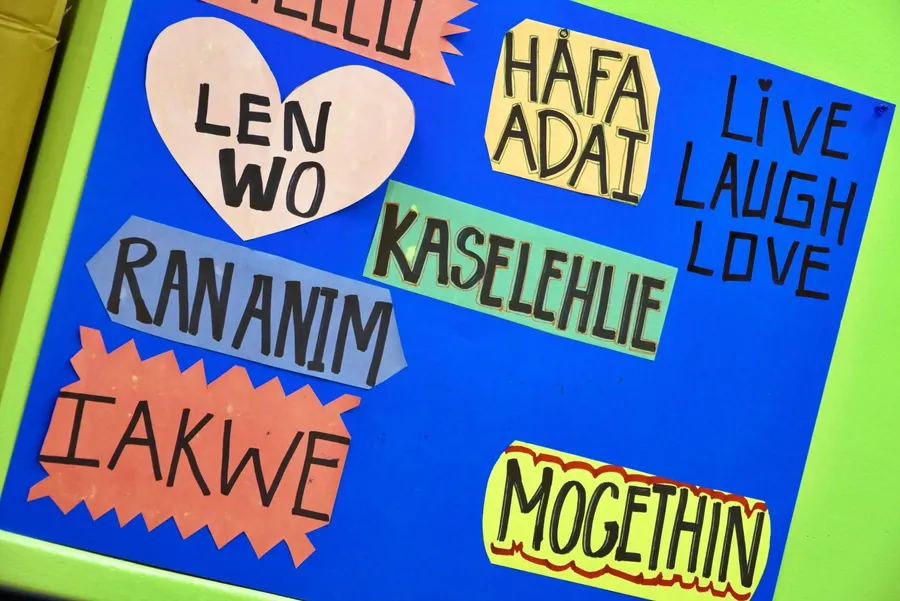
The Marshall Islands has two official languages, Marshallese and English. While English is widely spoken in Majuro, government offices and the tourism industry, Marshallese, or Kajin Ṃajeḷ, is the native language and the one most commonly spoken in homes and communities across the islands.
The Marshallese Language
Marshallese is an indigenous Micronesian language with two main dialects, Ratak and Rālik, named after the country's two island chains. Although the language was traditionally passed down orally, it now has a written form using the Latin alphabet with several unique letters and pronunciation marks.
Visitors will soon notice Marshallese words in everyday life, from greetings to place names. Learning a few simple phrases, such as iakwe ("hello" and "goodbye") and kommol ("thank you"), is always appreciated and is a great way to connect with local people.
Speaking English in the Marshall Islands
English is taught in schools and is commonly used alongside Marshallese, particularly in Majuro and Ebeye. Most hotel staff, tour operators and younger Marshallese speak good English, so communication is rarely difficult for visitors.
If you'd like to learn more about the language, useful phrases and how to pronounce Marshallese words, see What is the Marshall Islands Language?
-SEB%20CREDIT%20MarshallIslandsPocketGuide.com-900x601.webp?v=2026-07-10T20%3A39%3A54.070Z)
People and the Population of the Marshall Islands
The Marshall Islands has a population of 42,418 people, according to the 2021 census. While the country is spread across 29 atolls and five isolated islands, around 78% of the population lives in urban areas, primarily on Majuro and Ebeye, while the remaining population lives on the outer islands.
What is the Ethnic Makeup of the Marshall Islands?
The Marshall Islands is one of the most ethnically homogenous countries in the Pacific. The overwhelming majority of residents identify as Marshallese, with only small communities of people from elsewhere in the Pacific, Asia, the United States and other parts of the world.
This strong Marshallese majority means traditional customs, family ties, language and cultural values continue to shape everyday life throughout the country, even as modern influences become more common.
Where Do People Live in the Marshall Islands?
The country's largest population centre is Majuro, home to 23,156 people, making it the political, commercial and cultural heart of the Marshall Islands. The second-largest population centre is Kwajalein Atoll, including Ebeye, with 9,789 residents. Together, these two urban centres are home to most of the country's population.
Beyond the urban areas, the remaining population is spread across inhabited outer atolls such as Jaluit, Ailinglaplap, Arno, Wotje and Mili, where village life remains central to Marshallese culture.
The Marshall Islands also has a young population. According to the 2021 census, 34% of residents are under the age of 15, while the median age is just 22 years. In other words, family life, children and young people are at the heart of communities across the islands.
Learn more about the country's different atolls in The Atolls of the Marshall Islands & The Best to Visit.
-%20BNCC%20CREDIT%20MarshallIslandsPocketGuide.com-900x601.webp?v=2026-07-09T18%3A26%3A11.245Z)
Marshallese Customs
As discussed throughout this guide to Marshallese culture for travellers, the islands are wonderfully welcoming but come with a few important customs that should be kept in mind when visiting. Family, land, Christianity, hospitality and respect for others all shape everyday behaviour.
Clothing Etiquette in the Marshall Islands
When it comes to clothing, modesty is appreciated, especially in communities, shops, public offices and places of worship. Swimwear should stay at the beach or hotel pool, so bring something light to cover your shoulders, chest and upper thighs afterwards.
There is also some clothing etiquette to keep in mind for church. Women should generally cover their shoulders and knees, while men should wear trousers or smart shorts with a collared shirt. Think “Sunday best”, but without forgetting the tropical heat.
Other Marshallese Customs and Etiquette
Possibly the biggest thing for travellers to understand is that land, beaches, fishing areas and coconut trees usually belong to a family or community. Ask permission before entering unfamiliar land, fishing somewhere new or taking fruit and plants, even when somewhere looks completely unoccupied.
When entering a home, remove your shoes and wait to be shown where to sit. Avoid touching someone’s head, stepping over another person’s legs or walking between people who are talking. To beckon someone, hold your hand with the palm facing down rather than curling one finger upwards.
Hospitality is another important part of Marshallese life. Accepting at least a little food when it is offered is polite, while a warm smile and iakwe make an excellent start to most conversations. Visitors should also keep noise down around churches on Sundays, avoid public drunkenness and approach the relaxed pace of island life with patience and good humour.
Go into all of the details in Marshallese Etiquette: 25 Tips to Respect Marshall Islands Customs & Traditions.
More About the Marshallese Culture
That's it for our guide to More About the Marshallese Culture, but the culture is so complex that we certainly have more to say on the matter! Check out our other guides concerning the culture of the Marshall Islands:
- How Americanised are the Marshall Islands?
- Marshall Islands Etiquette: Marshall Islands Customs & Traditions
- 10 Best Historical Sites in the Marshall Islands
Finally, don't miss a thing about planning a trip to the Marshall Islands by checking out The Complete Travel Guide to the Marshall Islands and 30 Tips for Travelling in the Marshall Islands.

-SEB%20CREDIT%20MarshallIslandsPocketGuide.com-900x633.webp?v=2026-07-23T03%3A25%3A07.979Z)