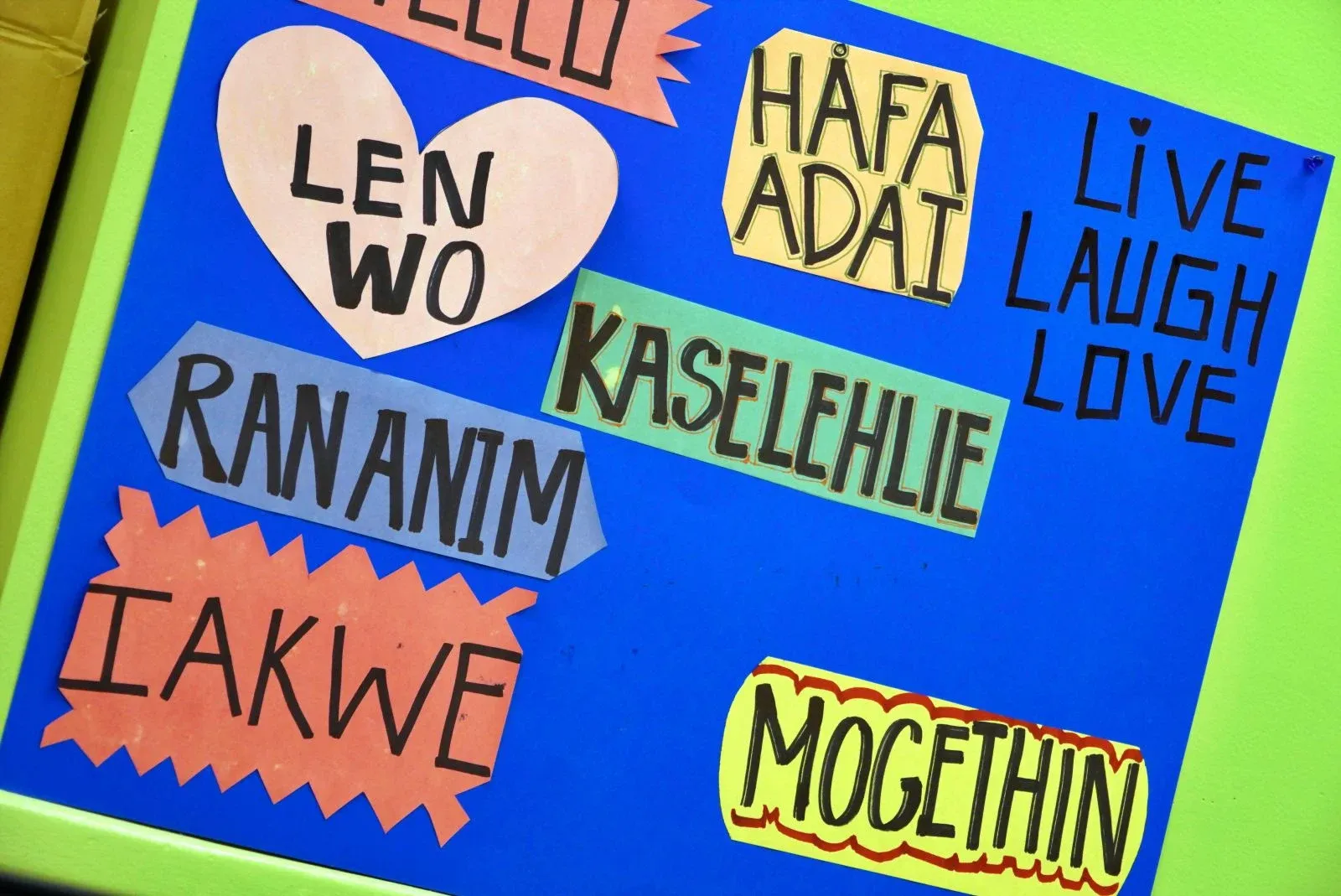
The Guide to the Marshall Islands Language: Kajin Ṃajeḷ
The Marshall Islands is home to two official languages: Marshallese and English. While English is the language that will help you get by in the Marshall Islands, Marshallese (or Kajin Ṃajeḷ in modern Marshallese spelling) is the native language and the language widely used by locals.
You’re bound to encounter plenty of Marshallese words and phrases during your getaway, from people greeting you with iakwe to you saying kommol after a little local help to working out whether you’re on the iar or the lik side of an island.
Learn a little about the Marshallese language, including words and phrases to know, in this quick guide to the language of the Marshall Islands.
This article is based on real on-the-ground research, not on AI scraping old content from the internet. Learn how we use AI!
Table of Contents
5 Fun Facts About the Marshallese Language
- Marshallese has two main dialects, Ratak and Rālik, named after the Marshall Islands’ two island chains. They are mutually intelligible, but some words are pronounced differently.
- You’ll see both old and new spellings in Marshallese, with modern spelling using macrons, dots and cedillas to better show the true sounds of the language.
- Marshallese has 24 letters in its modern alphabet, but you won’t find several English letters in there, including c, f, g, h, q, s, v, x, y and z. Instead, it uses letters with macrons, underdots or cedillas, such as ā, ḷ, ṃ, ṇ, ọ, ō and ū.
- Marshallese is an indigenous Micronesian language, but its vocabulary has borrowed words from Spanish, German, Japanese and English over time.
- The most common Marshallese greeting is iakwe (yok-way), which means both “hello” and “goodbye”, and is often said to literally mean “you are a love/rainbow”. Though there is still debate among locals about that last one.
-%20BNCC%20CREDIT%20MarshallIslandsPocketGuide.com-900x601.webp?v=2026-07-07T21%3A07%3A00.533Z)
Where Does Marshallese Come From?
For those of you who like a bit of context, Marshallese is part of the Micronesian branch of the huge Austronesian family of languages, more specifically the Eastern Oceanic subgroup. Its closest relative languages include Gilbertese, Nauruan, Pohnpeian, Mokilese, Chuukese, Refaluwasch and Kosraean.
Linguists have identified Formosa (Taiwan) as the homeland of the original Austronesian language, which ties neatly into the theory that the first settlers of the Pacific islands migrated out of Southeast Asia.
The Austronesian language family tree splits into two main branches at the top: the languages still spoken on Formosa today, and the Malayo-Polynesian languages, of which there are 880, including Marshallese.
That said, Marshallese is quite different from some of its Pacific neighbours, including Yapese in Yap State and Polynesian languages like Samoan, Tongan and Cook Islands Māori. So, no, one South Pacific phrasebook won’t magically unlock the whole ocean.
Marshallese was traditionally a spoken language with no written form for centuries, with history, navigation, customs and legends passed down verbally by elders and storytellers. A written form was later developed in the mid-19th century by Western Protestant missionaries, who adapted the Latin alphabet to the sounds they heard in order to translate the Bible and support formal schooling.
-SEB%20CREDIT%20MarshallIslandsPocketGuide.com-900x601.webp?v=2026-07-10T20%3A39%3A54.070Z)
Pronunciations in Marshallese
The first thing to know about pronunciations in Marshallese is that the current alphabet has 24 letters, though they are not the same as English: a, ā, b, d, e, i, j, k, l, ḷ, m, ṃ, n, ṇ, ñ, o, ọ, ō, p, r, t, u, ū and w. You may also see some of these letters written with cedillas instead of underdots, depending on the spelling system or font used.
How to Pronounce Consonants in Marshallese
Many Marshallese consonants are pronounced much like they are in English, but there are a few sounds that will catch English speakers out (because, of course, no language guide would be complete without a few curveballs).
As a simple guide:
- B is often closer to a soft “p” sound
- D is often closer to a soft “t” or light “r” sound
- J is often closer to a soft “j”, “ch” or “z” sound, depending on the word
- Ñ is pronounced like “ng” in “sing”
- Ḷ, ṃ and ṇ are heavier versions of l, m and n, pronounced with the sound made further back in the mouth
- W is pronounced like “w” in “water”
Don’t worry if that all sounds a little much at first. For visitors, getting the vowels and the rhythm roughly right will usually get you much closer than trying to perfect every consonant on day one.
How to Pronounce Vowels in Marshallese
Marshallese vowels are a little complex, as the language uses several vowel letters with macrons and underdots. For English speakers, here’s a rough guide:
- A as in “far”
- Ā as in “cat”
- E as in “let”
- I as in “marine”
- O as in “go”
- Ọ as in “hot”
- Ō like the “u” in “cup” or the “a” in “sofa”
- U as in “flute”
- Ū like “oo” in “food”, but with the lips a little more relaxed
These are approximations rather than perfect matches, but it gives you people reading in English a helpful place to start. Marshallese spelling is closely tied to pronunciation, so those little marks above and below letters are doing real work.
How to Pronounce Macrons, Underdots and Cedillas
A macron is the line above a letter, such as ā, ō and ū. In Marshallese, it does not simply mean “hold the vowel for longer” in the way it often does in other Pacific languages; it can signal a different vowel sound altogether.
Underdots or cedillas, such as ḷ, ṃ, ṇ and ọ, also change the sound. They are not extra syllables, so Ṃajeḷ is not “muh-aj-ee-luh”. A simple visitor-friendly attempt would be closer to “mah-zhel”, with the ṃ and ḷ pronounced a little deeper in the mouth.
You may see the same words written in slightly different ways, especially between older spellings, newer spellings and online dictionaries. The important thing to know is that modern spelling tries to show the actual sounds of Marshallese more accurately.
Old Spellings Vs. New Spellings in Marshallese
Wait, old spellings in Marshallese? That's right. Today, you’ll see both older and newer spelling systems used in the Marshall Islands, so don’t be surprised if the same word looks slightly different from one sign, book or website to the next.
Official spellings for the Marshallese language changed in May 2015 when the Marshallese Language Orthography (Standard Spelling) Act of 2010 was brought into effect.
The older spellings are still around on things like local newspapers, older signs and names that have stuck over time. The modern spelling system, meanwhile, uses helpful little marks such as macrons, dots and cedillas under letters to better reflect the true sounds of Marshallese.
In other words, those marks are not just there to make things look fancy (although they do keep your keyboard on its toes).
A Note on Marshallese Rhythm
One final thing to note about Marshallese pronunciation is that it has its own rhythm, and vowels can change slightly depending on the sounds around them. So, while the pronunciation list above is handy, listening to locals is still the best guide.
Marshallese Words and Phrases to Know
Here are a few useful Marshallese words and phrases to have in your back pocket while travelling in the Marshall Islands. The pronunciations in brackets are simple English-speaker guides.
Core Greetings and Everyday Etiquette in Marshallese
- Iakwe (yok-way) - Hello, love.
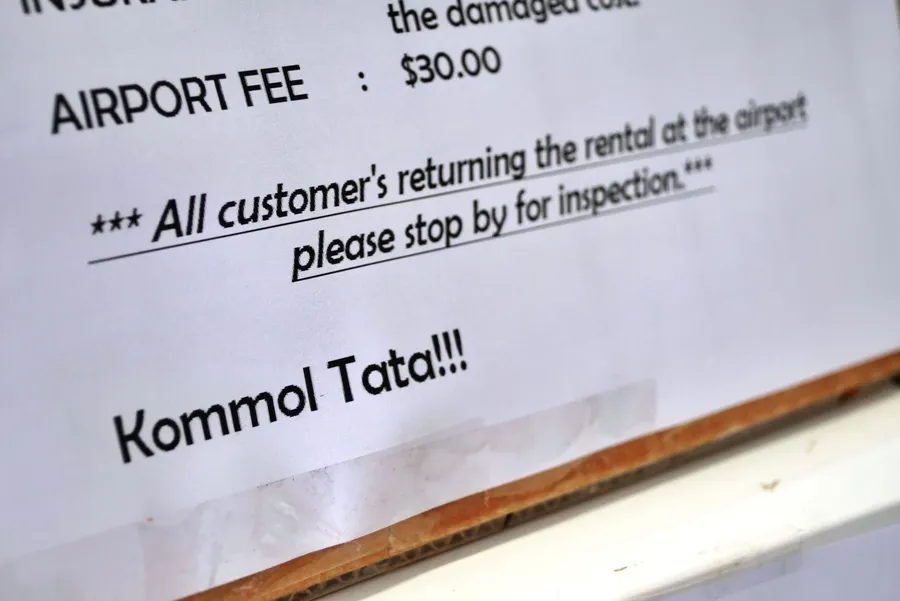
- Kommol (kohm-mohl) - Thank you.
- Kommool tata (kohm-mohl tah-tah) - Thank you very much.
- Kin jouj (kin joej) - You’re welcome.
- Ejet am mour? (eh-jet ahm moor) - How are you?
- Emman (em-mahn) - It’s good.
- Enana (eh-nah-nah) - It’s bad or tastes bad.
- Aaet (ah-yet) - Yes.
- Jaab (jahb) - No.
- Bōlen (bur-len) - Maybe.
- Jouj (joej) - Please.
- Jolok bod (joe-lok bod) - Excuse me or I’m sorry.
- Itok (ee-tok) - Come here.
- Etal (eh-tahl) - Go away.
- Mōn tutu (mern too-too) - Shower house or bathroom.
Basic Questions in Marshallese
- Ta? (tah) - What?
- Ta eo? (tah eh-oh) - What’s this?
- Won? (wuhn) - Who?
- Naat? (naht) - When?
- Etam? (eh-tam) - What’s your name?
- Eta in ____ (eh-tah een John) - My name is ____.
- Ewi Bank eo? (eh-wee bank eh-oh) - Where is the bank?
- Jete awa kiio? (jeh-teh ah-wah kee-oh) - What time is it?
- Jete onean? (jeh-teh oh-neh-ahn) - How much does it cost?
- Ij jab melele (eej jahb meh-leh-leh) - I don’t understand.
People and Everyday Words in Marshallese
- Na (nah) - I or me.
- Kwe (kweh) - You or you are.
- Emmaan (em-mahn) - Man or men.
- Kora (koh-rah) - Woman or women.
- Ajri (ahj-ree) - Children.
- Dreo (dreh-oh) - Good-looking woman.
- Wulio (woo-lee-oh) - Good-looking man.
- Takto (tahk-toh) - Doctor.
Food and Coconuts in Marshallese
- Mona (moh-nah) - Eat.
- Enno (en-noh) - Tastes good.
- Enno ke? (en-noh keh) - Does it taste good?
- Ni (nee) - Coconut tree or ripe green coconut.
- Waini (why-nee) - Mature brown coconut.
- Mōn ṃōñā (mern merng-ah) - Restaurant.
The Ocean, Islands and Activities in Marshallese
- Lojet / Lometo (loh-jet / loh-meh-toh) - Ocean.
- Lomalo / Malo (loh-mah-loh / mah-loh) - Lagoon.
- Iar (ee-ar) - Beach.
- Lik (lik) - Ocean-side beach.
- Bokbok / Mouj (bok-bok / mowj) - Used to describe a white sand beach.
- Tutu (too-too) - Swim.
- Tulok (too-lok) - Scuba dive or snorkel.
- Iik (eek) - Fish.
- Wod (wurd) - Reef or coral.
- Alwoj (ahl-woj) - Sightsee.
- Ean (eh-ahn) - North.
- Rak (rahk) - South.
- Reeaar (ree-ahr) - East.
- Ralik (rah-lik) - West.
Shopping and Money in Marshallese
- Wia (wee-ah) - Purchase or buy.
- Mōn wia (mern wee-ah) - Store.
- Amimono (ah-mee-moh-noh) - Handicrafts.
- Tala (tah-lah) - Dollar.
- Edik onean (eh-dik oh-neh-ahn) - It’s cheap.
- Elap onean (eh-lahp oh-neh-ahn) - It’s expensive.
Numbers in Marshallese
- Juon (joo-uhn) - One.
- Ruo (roo-oh) - Two.
- Jilu (jee-loo) - Three.
- Emen (eh-men) - Four.
- Lalem (lah-lem) - Five.
- Jilijino (jee-lee-jee-noh) - Six.
- Jiljilimjuon (jeel-jee-leem-joo-uhn) - Seven.
- Ruwalitok (roo-wah-lee-tok) - Eight.
- Ruwatimjuon (roo-wah-teem-joo-uhn) - Nine.
- Jonoul (jong-ohl) - Ten.
Now that you know the important words, check out how to say some iconic Marshallese meals in the Traditional Marshallese Food: 20 Foods to Try in the Marshall Islands.
-SEB%20CREDIT%20MarshallIslandsPocketGuide.com.webp?v=2026-07-09T18%3A48%3A21.399Z)
Frequently Asked Questions About Languages in the Marshall Islands
Clearly, a lot of you have been asking a lot of questions about Marshallese on the internet, and a surprising number of those questions have to do with flirting. We respect the commitment. Here are some quick answers to the most common Marshallese language questions.
What Are the Simple Marshallese Words?
Some simple Marshallese words to start with are iakwe for “hello”, koṃṃol or kommol for “thank you”, aet for “yes”, jaab for “no” and jouj for “please”. You’ll also hear koṃṃool tata, meaning “thank you very much”.
How Do You Say “Hi” in Marshallese?
To say “hi” in Marshallese, say iakwe (yok-way). It can mean “hello”, “goodbye” and “love”, a little like aloha in Hawaiian.
What Are the Basic Marshallese Phrases?
Basic Marshallese phrases include iakwe (hello/goodbye), koṃṃol (thank you), koṃṃol tata (thank you very much), kōn jouj (you’re welcome), jouj (please), aet (yes) and jaab (no).
A useful travel phrase is ij jab melele, meaning “I don’t understand”. Very handy for language learning and, let’s be honest, most travel situations.
How Do You Say “I Love You” in Marshallese?
A common way to say “I love you” in Marshallese is iọkwe eok, often seen in the older or more familiar spelling as iakwe yuk (yok-way yook). Because iakwe can also mean “hello” or “love”, context does a lot of the work here.
So yes, it’s sweet. Just maybe practice the pronunciation before your big moment.
How Hard Is Marshallese to Learn?
Marshallese can be challenging for English speakers because the pronunciation, spelling and sounds are quite different from English. The modern spelling system also uses marks such as macrons, underdots and cedillas to show sounds more accurately.
That said, learning a few everyday greetings and polite phrases is very achievable. Start with iakwe, koṃṃol and jouj, and you’re already off to a good start.
What Does tutu Mean in Marshallese?
In the phrase mōn tutu, tutu refers to bathing or showering, while mōn tutu means “shower house” or “bathroom”. In other words, a very useful phrase to recognise when travelling.
What Does yokwe Mean?
yokwe, also written in modern spelling as iakwe, means “hello”, “goodbye” and “love”. It can also be used as an expression of sympathy, making it one of the most important and versatile Marshallese words to know.
What Does komol tata Mean?
komol tata, more accurately written in modern spelling as koṃṃool tata, means “thank you very much”. Koṃṃool on its own means “thank you”.
What Does “Qué Lo Que” Mean?
“Qué lo que” is not Marshallese. It’s a Spanish/Caribbean slang phrase usually meaning something like “what’s up?” or “what’s going on?”
It can sound a tiny bit like iakwe to English-speaking ears, but no, it’s not the same thing. Wrong ocean, basically.
What Is “Thank You” in Marshallese?
“Thank you” in Marshallese is koṃṃool or kommool (kohm-mohl). To say “thank you very much”, say koṃṃool tata or kommool tata (kohm-mohl tah-tah).
What is jera in Marshallese?
jera is commonly used to mean “friend” or “mate”, although spellings can vary. As with many Marshallese words, you may see slightly different versions depending on whether older or newer spelling is being used.
What Does kora Mean in Marshallese?
kora is commonly used to mean “woman” or “female”. Again, spelling can vary a little between older and newer Marshallese writing systems, so don’t be surprised if you see it written differently.
How Do You Say “Beautiful” in Marshallese?
“Beautiful” in Marshallese can be expressed with aibujuij. For example, the phrase e-aibujuij means “it is beautiful”.
More About the Culture and Language of the Marshall Islands
That's it for our quick guide to the language of the Marshall Islands. For more Marshall Islands wisdom, take a look at these similar articles:
- A Traveller's Guide to the Marshall Islands Culture
- The Guide to the Religions in the Marshall Islands
- Marshall Islands Etiquette: Marshall Islands Customs & Traditions
And if you're planning a trip to the Marshall Islands, don't miss our Marshall Islands Travel Tips: 30 Tips for Travelling in the Marshall Islands.

-SEB%20CREDIT%20MarshallIslandsPocketGuide.com-900x633.webp?v=2026-07-23T03%3A25%3A07.979Z)