

-U%20CREDIT%20MarshallIslandsPocketGuide.com.webp?v=2026-07-16T06%3A45%3A57.632Z)
Scuba Diving Companies Providing Scuba Tours and Rentals in the Marshall Islands
Scattered across one of the most remote corners of the Pacific, the Marshall Islands offers the sort of diving that makes even well-travelled scuba enthusiasts check their air gauges twice. Think enormous coral formations, clear lagoon water, prowling sharks and wrecks carrying stories from another era.
When it comes to the best dive shops and operators in the Marshall Islands, quality most definitely wins over quantity. Around Majuro Atoll, you’ll find relaxed recreational dives and personalised courses, while remote Ailinglaplap Atoll delivers pristine resort diving just steps from a private-island stay.
Whether you’re taking your first breath underwater or planning an expedition that requires a little more than a mask and misplaced confidence, the Marshall Islands has an operator to point you in the right direction.
Ready to “dive” deeper into who can take you beneath the surface? Read on to discover the scuba diving operators, courses, charters and resort experiences available across the Marshall Islands.
This article is based on real on-the-ground research, not on AI scraping old content from the internet. Learn how we use AI!
Table of Contents
5 Quick Tips for Diving in the Marshall Islands
- Book Ahead. Dive operations are limited and departures are often arranged around individual bookings rather than fixed daily schedules. Contact your chosen operator early, particularly if you need rental gear, instruction or a private charter.
- Bring Personal Dive Gear Where Possible. Tanks, weights and buoyancy control devices are usually available, but wetsuit sizes and other rental equipment can be limited. At remote resorts, certified divers are encouraged to bring their own regulators, masks, snorkels and fins.
- Choose the Right Operator for Your Experience Level. Recreational lagoon dives are suitable for beginners, conservation-led training is available for new divers and remote resort diving is reserved for certified guests. Technical trips to Bikini Atoll are for ultra-experienced divers and should not be treated as a casual holiday dive.
- Check the Season and Site Conditions. Most diving around Majuro Atoll takes place year-round with warm water temperatures. However, some sites are tide-dependent, while diving at remote resorts is mainly offered during the watersports season from November to April.
- Expect Lagoon Diving to Take Centre Stage. Coral bleaching has affected some ocean-side sites, so local operators currently focus more heavily on lagoon reefs where coral health is better. You can still expect wrecks, coral formations, sharks, eagle rays and plenty of fish life, just without needing to battle the open ocean for every dive.
For more inspiration on where these operators might take you, check out The Best Scuba Diving in the Marshall Islands: Top Places to Dive.
What Scuba Diving Operators and Dive Shops are Available in the Marshall Islands
Scuba diving services in the Marshall Islands are limited but remarkably varied. Rather than choosing between rows of conventional dive shops, you’ll be deciding between accessible lagoon diving, conservation-focused instruction and a rather luxurious private-island escape.
Raycrew Marine Serives (Hiro)
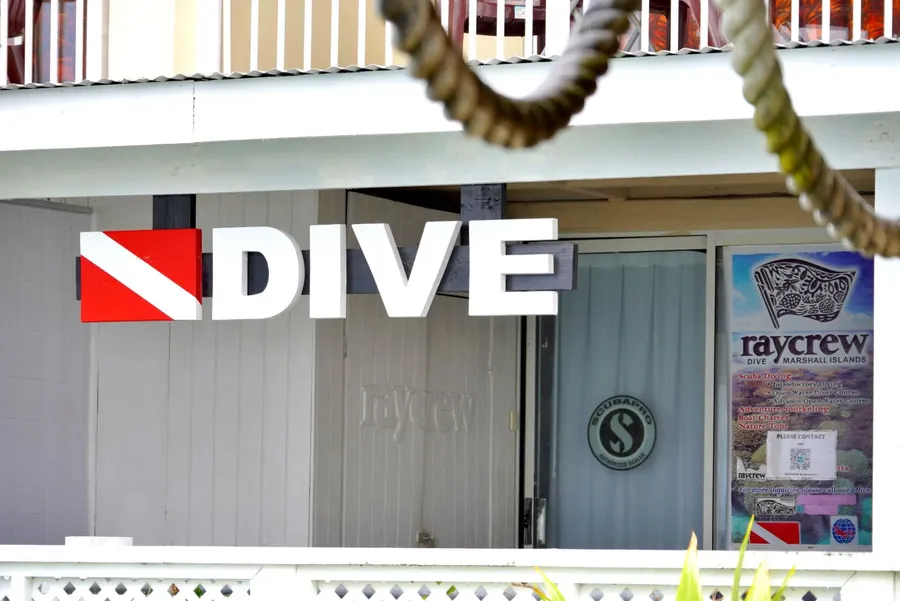
For straightforward recreational diving, Raycrew Dive is the main operator to know. Its experienced divemaster, Hiro, has been exploring and developing local dive sites since the 1990s, so there is plenty of first-hand knowledge beneath the surface (quite literally).
Raycrew currently uses around a dozen active sites, concentrating mainly on lagoon-side reefs where coral health remains good and covers wrecks, colourful coral formations, marine life and a few current-driven adventures.
Highlights include Enemanit Wrecks, where plane and shipwreck remains sit among coral heads, and No. 9, a reef dominated by enormous plates of yellow scroll coral. Eagle rays and sharks are sometimes seen here, while Mountain delivers exactly what its name promises: a mound of coral rising from around 98 ft (30 m) to just below the surface.
Raycrew’s relaxed style particularly suits beginners and recreational divers. The boat generally stays close to the action, most customers arrive as solo divers and snorkellers can often join the same trip.
Trips are not automatically private, so other guests may share the boat unless you book a private charter. Essential equipment such as a buoyancy control device, tanks and weights is available, although wetsuit sizes are limited (with water temperatures around 84°F (29°C), some divers may not miss one).
%20CREDIT%20MarshallIslandsPocketGuide.com-900x506.webp?v=2026-07-10T20%3A41%3A52.392Z)
Salty Services (Beven)
Salty Services offers a more occasional and conservation-led alternative to a conventional dive shop. It is run by Beven, who also works as the Marshall Islands Conservation Coordinator for The Nature Conservancy and joined National Geographic's Pristine Seas expedition not once but twice!
Beven’s diving work centres largely on incorporating scuba training into a college marine science programme, helping prepare the next generation of scientific divers. However, he also accepts individual learners and occasional visitors, particularly those interested in marine protected areas and the conservation stories behind them.
He works closely with Hiro from Raycrew Dive, with both operators charging the same rates and referring customers to one another. Simply put, English-speaking beginners are generally directed to Beven, while Hiro prefers teaching in Japanese.
Salty Services can arrange equipment rental through Raycrew Dive on your behalf. Otherwise, Salty Services is better understood as a personalised training and conservation service than a fully equipped, walk-in dive centre.
Beven also adds context to the underwater experience by explaining how local marine protected areas were established and what they are intended to protect. For divers who like a little science with their scenery, this is where the Marshall Islands becomes more than another pretty reef.
.webp?v=2026-07-13T22%3A03%3A05.266Z)
Beran Island Resort
For something altogether more remote, Beran Island Resort offers resort-based scuba diving in Ailinglaplap Atoll. This is not a dive shop for walk-in customers or a quick afternoon excursion, but a high-end private-island experience.
Diving is available directly from the resort dock, placing shallow coral gardens, walls and drift dives within easy reach of the rooms. Recreational sites are no deeper than 82 ft (25 m), with sharks, turtles, rays and other marine life found within the Marshall Islands’ vast shark sanctuary.
The general manager describes the visibility as exceptional and some of the pass dives as comparable to those of Fakarava in French Polynesia. Many sites around the atoll remain unexplored, which gives the experience a genuine expedition feel without requiring you to live aboard a research vessel and eat beans from a tin.
Beran does not provide scuba courses or instruction. Guests must already hold a current diving certification and should bring proof of it.
Buoyancy control devices, tanks and weights are available at the resort, although guests are encouraged to bring their own regulators, masks, snorkels, fins and, where practical, buoyancy control devices. Diving is included in stays during the watersports season from November to April.
Which Scuba Diving Operator to Choose in the Marshall Islands
In practical terms, choose Raycrew for relaxed recreational dives, Salty Services for English-language learning and conservation context or Beran Island Resort for remote diving as part of a luxury island stay.
-IC%26C%20CREDIT%20MarshallIslandsPocketGuide.com.webp?v=2026-07-09T19%3A16%3A22.395Z)
Diving Gear, Boats and Logistics in the Marshall Islands
Gear and transport arrangements vary considerably between the Marshall Islands’ dive operators, so it pays to check exactly what is included before turning up with nothing but a swimsuit and misplaced confidence.
Raycrew’s Gear and Boats
Raycrew includes a buoyancy control device, tanks, regulators, weights, mask, snorkel and fins, in its standard two-tank dive price. Wetsuits are also available, although sizes are limited, so bringing your own is recommended if fit and comfort are important to you.
With water temperatures around 84°F (29°C), some divers may prefer to dive without a wetsuit or use a lightweight rash vest.
Raycrew operates a 32-ft (9.75 m) Japanese flat deck sports boat named the Olivia II, featuring a custom wide hull built by Yamaha. This configuration provides an accessible and spacious flat deck layout for simple water entries and exits.
Salty Services’ Gear and Boat Arrangements
Salty Services does not operate as a conventional fully stocked dive centre. Instead, Beven works closely with Raycrew and arranges rental equipment through Hiro’s setup.
This means learners and visiting divers should confirm their equipment needs in advance rather than expecting to walk into a shop and choose from a full range of gear.
Beven’s boat is named Jinekjej, a word from the Bible that he describes as meaning “basket of charm” or “always bringing luck”. The boat comfortably fits around six passengers for scuba diving.
Beran Island Resort’s Gear and Access
At Beran Island Resort, tanks, weights and buoyancy control devices are available for certified guests. However, divers are encouraged to bring their own regulators, masks, snorkels, fins and, where practical, buoyancy control devices.
Bringing familiar equipment is especially sensible here because the resort is located in remote Ailinglaplap Atoll, where replacing a forgotten regulator is not quite as simple as popping down to the nearest dive shop.
While there are plenty of shore dive options, the day-to-day workhorse of the resort is the Trader Too, a 2007 Hatteras 54' Sport Fisher. The fast vessel cruises at 30 knots with a maximum of 40 knots.
%20CREDIT%20MarshallIslandsPocketGuide.com-900x507.webp?v=2026-07-09T19%3A15%3A22.767Z)
Scuba Diving Lessons and Courses in the Marshall Islands
Learning to scuba dive in the Marshall Islands is a much more personal affair than signing up at a large resort dive centre. Courses are arranged directly with the local operators, with Raycrew and Beven of Salty Services working closely together to match students with the most suitable instructor.
Open Water Courses With Raycrew
Hiro from Raycrew offers PADI Open Water training, with lessons particularly suited to Japanese-speaking students. He has decades of experience exploring local reefs and developing dive sites, so learners benefit from plenty of first-hand knowledge about lagoon conditions, marine life and safe diving around Majuro Atoll.
Courses can be organised over three days, making them possible to complete during a long weekend or a short stay in the capital. Equipment is arranged through Raycrew’s setup, although students should confirm what is available in their size before arriving.
Hiro generally refers English-speaking beginners to Beven, while Japanese-speaking students are more likely to train directly with Raycrew.
Open Water Courses With Salty Services
English-speaking learners are typically directed to Beven, who operates Salty Services.
His PADI Open Water course can also be completed in around three days, with the programme designed to suit visitors who do not have several weeks to spare. Equipment is supplied through Raycrew, so bookings and gear requirements should be arranged in advance, which can be handled through Beven.
Beven’s approach adds a strong conservation element to the course. Alongside the practical skills, students may learn about marine protected areas, reef management and the role scuba diving plays in local marine science.
%20CREDIT%20MarshallIslandsPocketGuide.com-900x507.webp?v=2026-07-09T19%3A15%3A28.647Z)
How Much Does Scuba Diving Cost in the Marshall Islands?
Scuba diving prices in the Marshall Islands depend on whether you join a scheduled trip, charter a boat, hire equipment or take a certification course. Here’s a general guide to what you can expect to pay.
Recreational Dives
A standard two-tank recreational dive costs around US$230 per person. A buoyancy control device, tanks and weights may be included, although inclusions vary, so always check before booking.
At remote island resorts, diving may be included in the accommodation rate during the main watersports season. Outside this period, individual dives can cost around US$50 per person for resort guests.
Private Boat Charters
A half-day private boat charter costs around US$680, while a full-day charter is approximately US$930.
These rates generally cover the boat rather than individual dive fees, making charters most practical for couples, families or small groups wanting a private day on the water.
An underwater dive guide for one diver costs around US$380. Confirm whether tanks, equipment and boat transport are included, as these may be charged separately.
Equipment Rental
Divers hiring equipment separately can expect to pay approximately:
- Regulator: US$20
- Buoyancy control device: US$20
- Mask, snorkel and fins set: US$20
- Wetsuit: US$10
- Tank: US$10
- Weights: US$1 per lb, or included with some dive packages
Equipment availability may be limited, particularly for wetsuits and less common sizes. Bringing your own mask and other personal gear is recommended if comfort is important to you.
PADI Certification Courses
A PADI certification course for two people costs around US$920, including rental equipment. Training in pairs is the preferred arrangement, allowing students to complete the practical sessions together.
A solo PADI course costs around US$460.
Discover Scuba Diving
A PADI Discover Scuba Diving experience, also known as an introductory dive, costs around US$290 for two people. This is the preferred booking arrangement for couples or friends trying scuba for the first time.
A solo introductory dive costs around US$230.
Unlike a full certification course, an introductory dive provides a supervised first experience underwater rather than a permanent diving qualification.
More About Scuba Diving in the Marshall Islands
That’s it for our guide to scuba diving in the Marshall Islands; for more information about exploring the country’s reefs, wrecks and marine life, check out the following articles:
- The Best Scuba Diving in the Marshall Islands: Top Places to Dive
- The Best Snorkelling in the Marshall Islands
- 10 Best Snorkelling Tours in Majuro
Finally, if there’s anything we’ve missed, you’re likely to find it in The Complete Travel Guide to the Marshall Islands.

-S%20CREDIT%20MarshallIslandsPocketGuide.com-900x345.webp?v=2026-07-23T03%3A40%3A08.241Z)
-SEB%20CREDIT%20MarshallIslandsPocketGuide.com-900x506.webp?v=2026-07-19T00%3A06%3A29.505Z)