

-%20BNCC%20CREDIT%20MarshallIslandsPocketGuide.com.webp?v=2026-07-17T08%3A11%3A47.485Z)
The Animals and Birds You’ll See in the Marshall Islands (+ A Couple of Endemics)
The Marshall Islands may look peaceful from above, but beneath the surface, in the forest canopy and across its remote islets, wildlife is everywhere. From an endemic clownfish with an all-black makeover to giant clams, reef sharks, noddies and coconut crabs, the country’s atolls support an impressive collection of animals.
Many of the best encounters happen in the outer atolls of the Marshall Islands. However, as most people spend time in Majuro, we've been sure to mainly stick to the wildlife you're likely to see in and around the main atoll too.
Colourful sponges, towering walls of yellow scroll coral and curious reef creatures fill the underwater landscape. Venture farther afield and remote atolls become vital nesting grounds for sea turtles, seabirds and other species that rely on these isolated islands.
We have seen several of these creatures ourselves, while others have remained frustratingly hidden in the trees (you know who you are, Micronesian imperial pigeon). So, whether you are snorkelling from shore, diving a lagoon pinnacle or checking the barbecue shelter for spiders, here are some fascinating animals, birds and other living things found in the Marshall Islands.
This article is based on real on-the-ground research, not on AI scraping old content from the internet. Learn how we use AI!
Table of Contents
1.Bwilōn (Three-Banded Anemonefish)
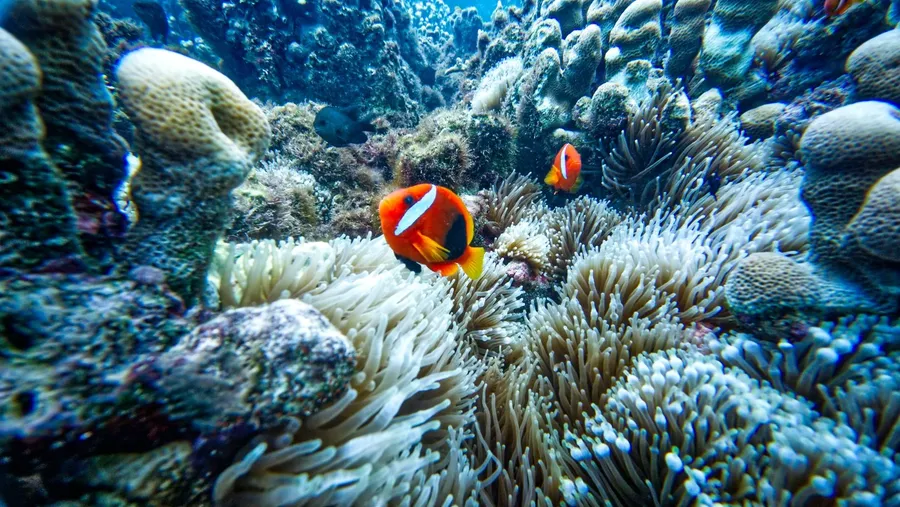
Found nowhere else in the world, the three-banded anemonefish (Amphiprion tricinctus or bwilōn in Marshallese) is a colourful little celebrity of the Marshall Islands’ reefs. Also known as the three-stripe clownfish, it can appear bright orange or in a striking melanistic, almost entirely black form, with both colour variations sporting three white vertical bands.
Like other anemonefish, it lives safely among the tentacles of sea anemones and follows a strict size-based social hierarchy. It is also a sequential hermaphrodite, meaning the dominant fish can change sex to become the breeding female (reef life is rarely boring).
Divers regularly spot the species around Kwajalein and Bikini Atoll, particularly on seaward reef slopes, underwater pinnacles and historic shipwrecks. Some have even been spotted deeper than 131 ft (40 m)!
Needless to say, we haven't seen one of these bad boys ourselves, so here is a photo of another type of anemonefish until that lucky day arrives!
2.Ṃuḷe (Ratakensis or Micronesian Imperial Pigeon)
-SEB%20CREDIT%20MarshallIslandsPocketGuide.com-900x601.webp?v=2026-07-10T20%3A41%3A08.856Z)
Another endemic one for you, the Micronesian imperial pigeon (Ducula oceanica or ṃuḷe in Marshallese) is a vulnerable forest bird found across parts of Micronesia, including the Marshall Islands. Birds living along the Ratak Chain belong to the endemic subspecies ratakensis, making them one of the region’s more distinctive feathered residents.
These large pigeons depend on native forest, mangroves and beach vegetation for food and shelter. Their fruit-heavy diet also makes them important seed dispersers, helping plants spread between the scattered forests of the atolls.
Confirmed habitats include Mili Atoll, particularly Nallu Islet and the northwestern corner of the atoll, as well as the northeastern islets of Majuro Atoll, where breeding populations have been recorded. They may also occur on other outer atolls with suitable forest.
This is another bird we have not managed to photograph, so you will have to make do with a landscape photo instead. There may well be a pigeon hiding somewhere in the forest canopy...
3.Kurkurbale (Hawaiian Garden Spider)
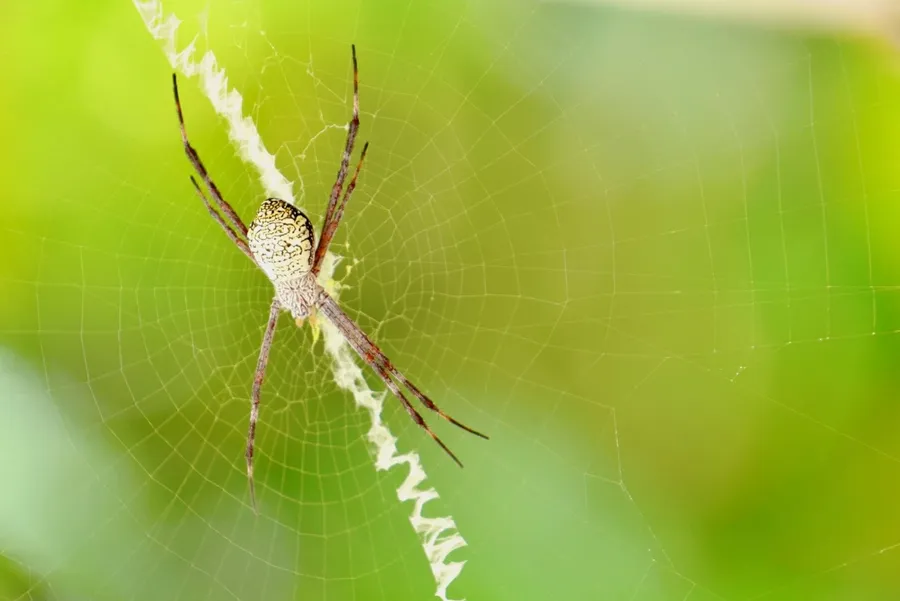
The Hawaiian garden spider (Argiope appensa) is the only member of its genus recorded in the Marshall Islands. This large, colourful orb-weaver is found throughout Micronesia and the western Pacific, where its impressive webs are often easier to spot than the spider itself.
Females are the real showstoppers, with bold yellow, black and silver markings and a leg span of up to 2.8 in (7 cm). Males are much smaller and less colourful, measuring around 0.8 in (2 cm).
Look closely at the web and you may notice a thick zigzag of white silk through the centre, known as a stabilimentum. Scientists think this may warn birds away from the web or help camouflage the spider from predators, although the spider is keeping its design brief rather secret.
In the Marshall Islands, these adaptable spiders live in tropical forests, savannas, gardens and beside jungle trails. We found the one pictured on Eneko Island, Majuro, hanging out in the barbecue shelter.
4.Pejwak and Jekar (Black and Brown Noddies)
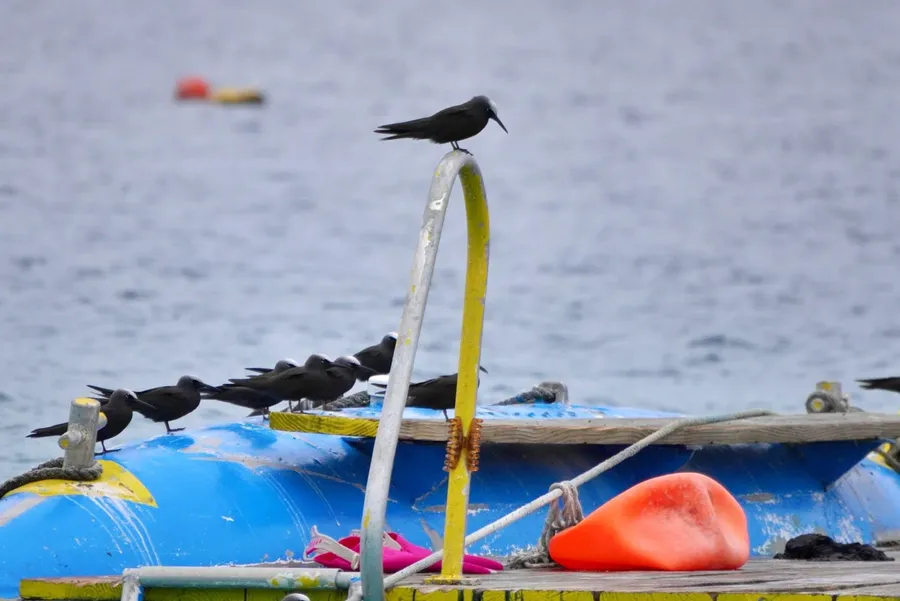
Two noddy species are commonly seen across the Marshall Islands: the brown noddy (Anous stolidus), known locally as pejwak, and the black noddy (Anous minutus), or jekar. These small tropical seabirds are present throughout the year, often gathering in huge feeding flocks over schools of fish.
The brown noddy is the larger of the two, with dark brown plumage, a slightly paler crown and a gently curved bill. It usually nests in low trees, shrubs or on raised rocky ledges, often alongside dozens of equally noisy neighbours.
The black noddy is smaller and almost black, with a bright white cap and a straighter, proportionally longer bill. Large colonies can make quite a racket from the treetops.
Look for both species around uninhabited islets and forested shorelines. At sea, watch for what locals sometimes describe as “bird piles”, swirling groups of noddies diving above feeding fish. We've even experienced this while snorkelling around the northern atolls of Majuro!
5.Pako (Shark)
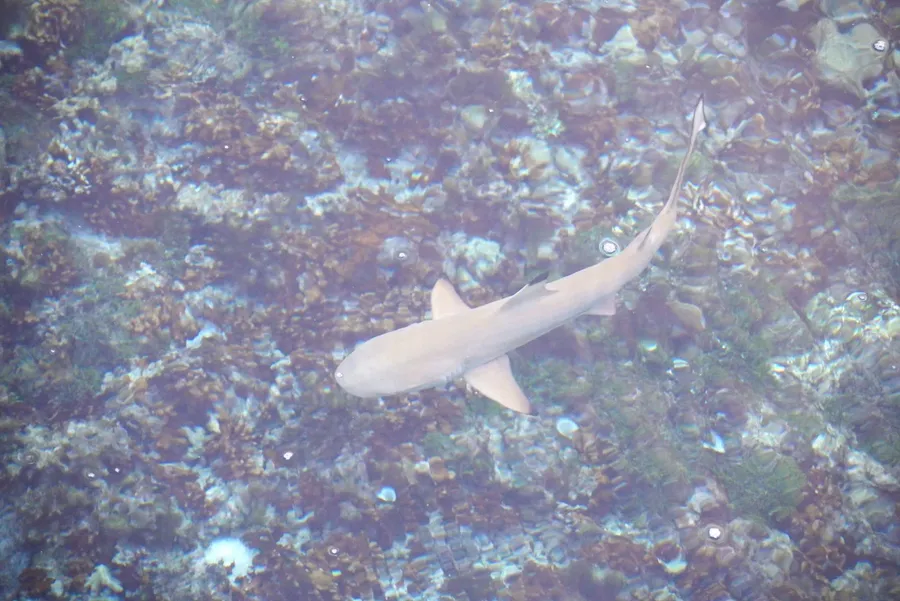
The Marshall Islands is one of the best places in the Pacific to see sharks, helped by a nationwide shark sanctuary covering the country’s entire 768,547 mi² (1,990,530 km²) Exclusive Economic Zone. Established in 2011, the sanctuary prohibits commercial shark fishing and the trade of shark products, giving both reef and ocean-going species room to thrive.
Around Majuro Atoll, the shark you are most likely to see while snorkelling is the blacktip reef shark (Carcharhinus melanopterus). Look for the dark markings on its fins as it patrols shallow lagoon water, reef flats and sandy shorelines, sometimes in water barely deep enough to justify putting your mask on.
Whitetip reef sharks (Triaenodon obesus) are also common, although they often spend the day resting beneath coral ledges or on sandy patches. Tawny nurse sharks (Nebrius ferrugineus) can occasionally be found sheltering beneath reef shelves around Majuro’s lagoon and channels.
Divers exploring outer reefs and steep drop-offs around Kwajalein, Bikini and Enewetak Atoll may encounter grey reef sharks, silvertip sharks and, less frequently, tiger sharks. Silky sharks, oceanic whitetip sharks, scalloped hammerheads and whale sharks are more likely to appear in deeper offshore water than beside the beach.
For particularly shark-rich waters, remote northern atolls such as Bikar, Taka and Bokak Atoll support relatively undisturbed marine ecosystems. Access can be difficult, however, so most travellers will have their best chance of an encounter by joining a local dive or snorkelling trip from Majuro or Kwajalein. In our experience, Bokanbotin Island Resort was a guarantee for seeing small reef sharks!
Reef sharks generally keep their distance from swimmers, but give them plenty of space, avoid blocking their route, and never attempt to feed or touch them. Watching a blacktip glide past is thrilling enough without trying to turn the experience into an underwater handshake.
6.Kapwōr (Giant Clam)
%20CREDIT%20MarshallIslandsPocketGuide.com.webp?v=2026-07-09T18%3A46%3A46.238Z)
The reefs and lagoons of the Marshall Islands support colourful populations of giant clams, with Tridacna maxima the species you are most likely to spot on shallow reef tops. Despite the name, this particular giant clam usually reaches around 12 in (30 cm), which is still a fairly impressive shellfish.
You may also see Tridacna squamosa, a medium-sized species that anchors itself firmly to the reef. Larger species, including Tridacna gigas and Tridacna noae, are occasionally recorded in deeper lagoons and along seaward reefs.
Giant clams help keep reef ecosystems healthy while also supporting local livelihoods. The Marshall Islands Mariculture Farm, also known as the MIMF Clam Farm, works with families and outer-island farmers to raise clams in lagoon cages for local consumption and the international aquarium trade.
Around Majuro Atoll, snorkellers can find giant clams protected within the conservation area of Bokanbotin Island Resort. You can also enquire about visiting the mariculture facility to see how the clams are spawned and raised, although tours should be arranged in advance.
Look closely and you may notice shimmering blue, green or gold patterns across the clam’s exposed mantle. Just admire them where they are, these reef residents have already put down roots and are not keen on relocating.
7.Wõn (Turtle)
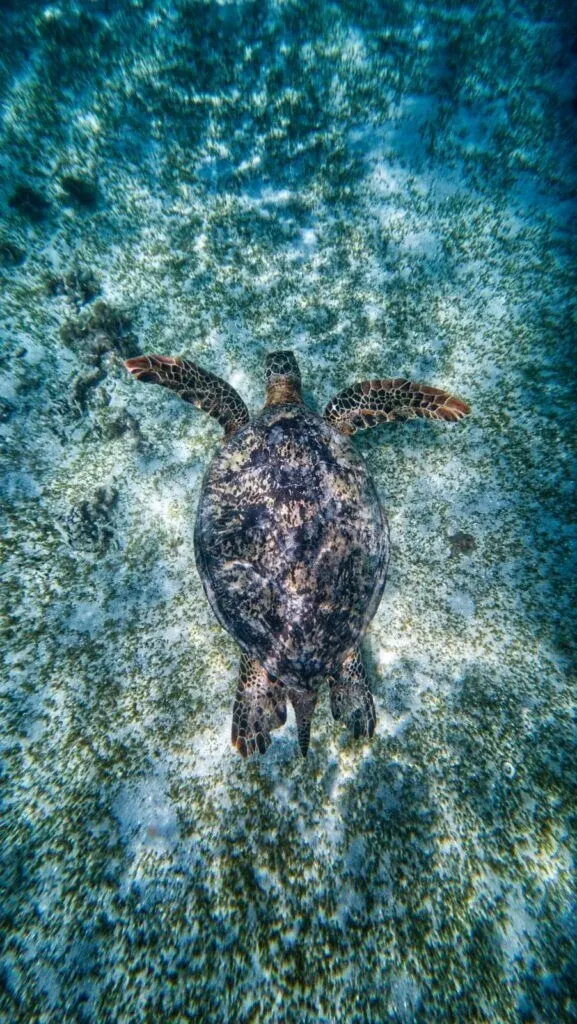
Four sea turtle species have been recorded in the waters of the Marshall Islands: the green turtle (Chelonia mydas), known locally as wõn, the hawksbill turtle (Eretmochelys imbricata), or jõbake, the leatherback turtle (Dermochelys coriacea) and the olive ridley turtle (Lepidochelys olivacea).
Green turtles are the species you are most likely to encounter, particularly while snorkelling in reef lagoons where they graze on seagrass and algae. Hawksbill turtles are less common and usually forage around coral reefs, where their narrow beaks help them reach food tucked between the coral.
The remote northern atolls of Bikar, Bokak, also known as Taongi, and Jemo provide internationally important nesting habitat. Green turtles generally come ashore on isolated beaches between May and November, while leatherback and olive ridley turtles are rarely seen near land and are more often recorded in offshore waters.
Sea turtles have long featured in Marshallese stories, traditions and food culture, although harvesting is now controlled by the Marshall Islands Marine Resources Authority (MIMRA). Eggs and nesting turtles are protected, while additional restrictions apply to hawksbill turtles, so visitors should never disturb a turtle, nest or marked nesting beach.
Traces of historic nuclear contamination have also been detected in green turtles studied around Enewetak Atoll and Bikini Atoll, a sobering reminder of the region’s 20th-century history. Fortunately, the turtle’s preferred response to human drama remains the same: keep swimming and look wonderfully unbothered.
8.Yellow Scroll Coral
-U%20CREDIT%20MarshallIslandsPocketGuide.com-900x507.webp?v=2026-07-09T19%3A16%3A36.322Z)
Yes, coral is a living thing, so it absolutely counts for this list (and frankly, some colonies are doing a better job of looking alive than we do before coffee). Yellow scroll coral (Turbinaria reniformis) is particularly impressive when it forms an enormous wall of layered plates.
Usually bright yellow or yellow-green, the coral grows in folded plates, chalices and whorls that resemble scrolls or a giant cabbage. Individual colonies can exceed 16 ft (5 m) across, creating dramatic underwater landscapes rather than just another small patch of reef.
Yellow scroll coral is widespread across the Indo-West Pacific and especially abundant in the Marshall Islands. It grows on lagoon patches, mid-lagoon pinnacles and seaward reefs at depths of around 7 to 66 ft (2 to 20 m), tolerating both clear water and murkier fringing-reef conditions.
We saw a particularly spectacular wall of it at No. 9 Dive Site in Majuro Atoll, although we are sure there are many more impressive colonies around the country. Look rather than touch, as this vulnerable coral has spent years building its underwater architecture and probably will not appreciate an unsolicited renovation.
9.Tube Sponge
-U%20CREDIT%20MarshallIslandsPocketGuide.com-900x507.webp?v=2026-07-09T19%3A16%3A33.183Z)
And yes, sponges are animals too. The blue-grey tube sponge (Niphates olemda) is a striking lagoon species found throughout the Marshall Islands, from Majuro to Kwajalein Atoll and well beyond.
It grows in prominent blue-to-grey tubular colonies, often forming clusters that stand out clearly against the surrounding reef. These hollow branches also provide useful hiding places for small marine creatures, including the symbiotic shrimp Thaumastocaris streptopus.
Rather than eating the sponge, these tiny residents shelter safely inside its tubes, turning each colony into something of an underwater apartment block. The sponge itself filters food from the surrounding water while quietly providing habitat for the neighbours.
Look for it on lagoon reefs, coral outcrops and sheltered underwater slopes. It is widespread across the islands, although its colour and shape make it particularly easy to notice while diving in clear lagoon water.
We've seen these guys all over Majuro: Eneko Island, Enenanmit Island and No. 9 are a few named spots we can offer.
10.Baru (Crab)
-%20BNCC%20CREDIT%20MarshallIslandsPocketGuide.com-900x601.webp?v=2026-07-09T18%3A29%3A52.537Z)
A special shoutout has to go to the crabs of the Marshall Islands, especially these guys we took a photo of at the pier next to the Majuro Bridge. From beaches and seawalls, reef flats to forest floors, they turn up almost everywhere.
The headline act is the coconut crab (Birgus latro), the world’s largest land-dwelling arthropod. These powerful nocturnal foragers hide beneath vegetation or in burrows by day, then emerge after dark to feed on coconuts, fruit and nuts.
You are more likely to encounter coconut crabs on quieter outer islands such as Jemo Island, although populations have declined in some areas due to harvesting. They remain an important traditional food, so local bans and customary restrictions help protect them.
The lagoons and reefs of Kwajalein Atoll also support box crabs, coral crabs and heavily camouflaged potato chip crabs. Look across sandy bottoms and rocky intertidal areas, although many species are experts at pretending to be anything except a crab.
Hermit crabs are the easiest to find, particularly strawberry hermit crabs (Coenobita perlatus) and rugose hermit crabs (Coenobita rugosus) along most island shorelines. Marine species, including the white-spotted hermit crab (Dardanus megistos), roam shallow reef flats and lagoon bottoms in borrowed shells.
Give any coconut crab plenty of space and keep food securely packed away at campsites. Those claws are built for cracking shells, and your snack bag is unlikely to present much of a challenge.
More About Animals and Birds in the Marshall Islands
That's it for our list of animals and birds found in the Marshall Islands. For more information about experiencing animals and birds while visiting the Marshall Islands, check out the following articles:
- 10 Best Boat Tours in Majuro & the Marshall Islands
- The Best Dive Shops & Operators in the Marshall Islands
- 5 Best Snorkelling Tours in Majuro & the Marshall Islands
Finally, plan more of your Marshall Islands itinerary using the 101 Best Things to Do in the Marshall Islands: The Ultimate List.

-S%20CREDIT%20MarshallIslandsPocketGuide.com-900x345.webp?v=2026-07-23T03%3A40%3A08.241Z)
-SEB%20CREDIT%20MarshallIslandsPocketGuide.com-900x506.webp?v=2026-07-19T00%3A06%3A29.505Z)